
Executive Summary
The 2024 Lead and Copper Rule Improvements (LCRI) fundamentally restructured water utility lead service line replacement obligations, establishing a mandatory 10-year replacement timeline and lowering the action level to 10 parts per billion (ppb). The Environmental Protection Agency (EPA) estimates $1.47 to $1.95 billion in annual costs offset by $13.49 to $25.14 billion in annual health benefits—a benefit-to-cost ratio exceeding 13:1.
Water utilities face substantial financial and operational challenges in implementing lead service line (LSL) replacement at scale. The federal government allocated $15 billion through the Infrastructure Investment and Jobs Act (IIJA), yet estimated replacement costs range from $45 billion to over $100 billion nationally. A funding gap of $30 billion to $85 billion creates acute pressure on utilities to develop sustainable cost recovery mechanisms and navigate complex rate design decisions.
Rate design strategy directly determines whether replacement programs are financially viable and equitable. Utilities can recover LSL costs through base rate increases, dedicated surcharges, or distributed cost-of-service methodologies. Each mechanism carries distinct affordability implications, particularly for low-income households already spending 4.5% to 10% of household income on water services. States employing comprehensive cost recovery frameworks—including statutory recovery mechanisms, accelerated depreciation, and customer assistance programs—demonstrate superior compliance trajectories and more predictable funding paths.
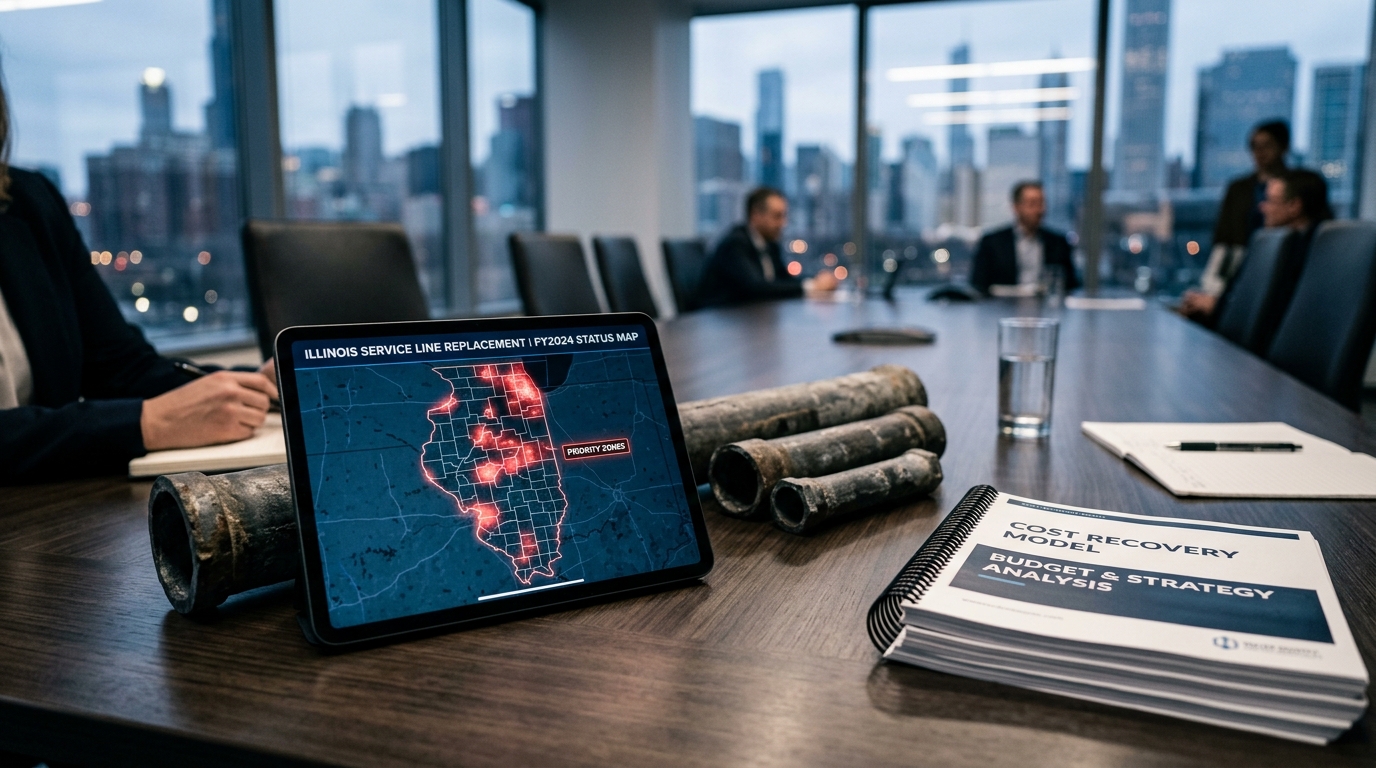
State-level statutes layered on top of LCRI compress already-tight federal timelines and force decisions on cost allocation. Illinois's Lead Service Line Replacement and Notification Act (LSLRNA) is the most aggressive of these state frameworks: it requires every community water supply to submit a final, IEPA-approvable comprehensive replacement plan by April 15, 2027—roughly seven months ahead of LCRI's federal baseline inventory date. The Illinois plan must specify replacement sequencing, financing, customer notification protocol, and—critically—how much of the customer-side ("private side") replacement cost the municipality will fund. Early Illinois data points illustrate the financial scale: Oak Park, an inner-ring Chicago suburb of roughly 12,500 service connections, faces a $300–$400 million all-in program cost in scenarios presented to its Board of Trustees in 2026, equivalent to $24,000–$32,000 per connection—two to four times the AWWA mid-range and a leading indicator for similar communities across the Rust Belt.
This report analyzes the regulatory architecture governing LSL replacement (federal LCRI and the most consequential state mandates), quantifies the true cost burden on utilities and customers, examines rate design approaches validated by state public utility commissions, and identifies affordability safeguards required to protect vulnerable populations. The analysis incorporates recent EPA guidance, state statutory frameworks, real utility implementation data, the emerging Illinois LSLRNA caseload, and litigation dynamics surrounding LCRI compliance and constitutionality.
Regulatory Evolution: From LCR to LCRI
The 1991 Lead and Copper Rule Foundation
The original Lead and Copper Rule (LCR), promulgated in 1991 and codified at 56 Federal Register 26460, established the foundational regulatory framework for lead control in drinking water systems. The rule mandated an action level of 15 ppb, above which utilities were required to implement corrosion control treatment and public education. Critically, the 1991 rule did not mandate lead service line replacement; instead, it permitted utilities to address elevated lead through treatment optimization and voluntary replacement programs.
The 15 ppb action level remained unchanged for three decades despite accumulating epidemiological evidence linking lead exposure to irreversible neurodevelopmental damage, particularly in children under six years of age. An estimated 9.2 million lead service lines remained in service nationally under this framework, with replacement occurring only in isolated cases driven by main breaks or customer initiative.
The 2021 Lead and Copper Rule Revisions
The Lead and Copper Rule Revisions (LCRR), finalized January 23, 2021, and published at 86 Federal Register 4198, represented the first substantial modification to lead regulation in 30 years. The LCRR lowered the action level to 10 ppb and introduced a new trigger level of 15 ppb, below which utilities could petition for reduced monitoring frequency. More significantly, the LCRR mandated that utilities develop comprehensive service line inventories identifying all service lines, including those composed partially or entirely of lead.
The inventory requirement imposed substantial compliance costs and data management burdens. Utilities were required to consolidate information from multiple sources—historical records, water main material information, meter locations, and property records—to develop accurate system-wide inventories. Inventory completion deadlines were set for October 16, 2024, creating immediate financial pressure on utilities unprepared for large-scale data collection and verification projects.
The 2024 Lead and Copper Rule Improvements (LCRI)
The Lead and Copper Rule Improvements (LCRI), finalized March 14, 2024, and published at 89 Federal Register 86418, fundamentally restructured lead service line regulation by mandating replacement rather than treatment as the primary compliance strategy. The LCRI eliminated the trigger level, maintaining only the 10 ppb action level, and established a binding 10-year replacement schedule: systems must replace 10% of identified lead service lines in the first three years, with complete replacement no later than November 1, 2037.
| Rule Version | Action Level (ppb) | Replacement Mandate | Key Requirement | Effective Date |
|---|---|---|---|---|
| 1991 LCR | 15 | No | Corrosion control treatment | June 19, 1992 |
| 2021 LCRR | 10 | No (encouraged) | Service line inventory | Jan 23, 2021 |
| 2024 LCRI | 10 | Yes, 10-year mandate | Mandatory replacement schedule with cost recovery plan | March 14, 2024 |
The LCRI compliance timeline establishes three critical milestones. The initial inventory deadline of October 16, 2024, required utilities to identify which service lines are lead, galvanized, or unknown composition. The baseline inventory deadline of November 1, 2027, allows utilities to refine inventory accuracy and commence baseline replacement planning. The final compliance deadline of November 1, 2037, requires 100% replacement of all identified lead service lines.
The LCRI's 10-year replacement window is epidemiologically aggressive but operationally achievable. Utilities replacing 10% annually across all service line categories can meet the mandate while maintaining system stability and customer service continuity. Utilities with fragmented or unreliable inventory data face substantially elevated compliance risk and should prioritize inventory verification in 2026-2027 to ensure accurate replacement planning by November 2027.
Litigation and Regulatory Uncertainty
The American Water Works Association (AWWA) filed suit challenging LCRI constitutionality in December 2024, arguing in the D.C. Circuit (Case No. 24-1283) that the EPA exceeded its statutory authority under the Safe Drinking Water Act by mandating utility-side LSL replacement absent explicit statutory language. AWWA contends that the Cost-Benefit Analysis underlying LCRI underestimates replacement costs—EPA's $4,700 to $6,930 per-line estimate substantially underestimates actual costs documented at $8,247 to $12,000+ per line in published utility reports.
The litigation trajectory remains uncertain, but three outcomes are plausible: (1) the D.C. Circuit upholds LCRI as within EPA's statutory authority; (2) the court remands LCRI for cost recalculation; or (3) the court vacates the replacement mandate while permitting the action level reduction and inventory requirement. Utilities should proceed with compliance preparation assuming LCRI remains in force, while monitoring litigation developments quarterly and maintaining contingency planning for alternative regulatory scenarios.
State Implementation Landscape
State governments have adopted divergent regulatory approaches to LSL replacement, ranging from state-mandated timelines that exceed federal requirements to cost allocation models that shift financial responsibility to customers or property owners. State frameworks operate independently of federal LCRI, creating a layered regulatory environment where utilities must comply with the more stringent standard.
Extended State Mandates
Illinois enacted the Lead Service Line Replacement and Notification Act (LSLRNA, Public Act 102-0613) effective January 1, 2022, establishing the most comprehensive state-level lead service line replacement framework in the country. The LSLRNA covers an estimated 686,000 to 1,040,000 lead and galvanized-requiring-replacement service lines statewide—the largest known LSL inventory in any state—and establishes a tiered, mandatory replacement schedule that varies by system size: communities with 1,200 or more affected lines have up to 50 years to complete replacement; those with 600–1,199 have 40 years; 100–599 have 30 years; and the smallest systems must replace at least 7 lines per year. Replacement obligations begin in 2027 across all tiers.
The LSLRNA's near-term forcing function is the April 15, 2027 final comprehensive replacement plan deadline. Each community water supply must submit a complete, IEPA-approved replacement plan—covering inventory verification, replacement sequencing, financing strategy, and customer notification protocol—by that date. The final plan deadline is preceded by a cascade of interim filings: the initial material inventory was due April 15, 2022; the final inventory was due April 15, 2024; and an initial replacement plan with annual updates is required each April 15 thereafter. Utilities that fail to submit an approvable final plan face IEPA enforcement and potential loss of state revolving fund eligibility.
The LSLRNA's interaction with federal LCRI creates a compressed compliance environment in Illinois unlike that of any other state. The state statute permits multi-decade replacement timelines, but LCRI's November 1, 2037 federal completion deadline preempts state timelines for most utilities, collapsing 30- to 50-year statutory programs into the federal 13-year window. Utilities that built financing strategies around the LSLRNA's longer horizon must now redesign rate structures around LCRI's accelerated schedule. The statute is explicit on certain obligations—municipalities must replace the entire service line, including the customer-side portion, when using state or federal funds—but silent on cost allocation methodology where municipalities self-fund, creating substantial ambiguity around private-side funding decisions that have become politically charged in many Illinois communities.
Michigan enacted legislation establishing a 20-year state replacement window, with an estimated 300,000 to 500,000 lead service lines statewide. Michigan's framework requires utilities to prioritize low-income neighborhoods and schools, embedding equity considerations directly into compliance obligations. The state has not, however, established a uniform cost recovery mechanism, leaving individual utilities to negotiate recovery with the Michigan Public Service Commission on a case-by-case basis.
New Jersey enacted Public Law 2021 Chapter 183, mandating replacement of all service lines identified as lead by December 31, 2031, establishing a 7-year replacement window more accelerated than the federal LCRI 10-year timeline. New Jersey American Water implemented this mandate through a semi-annual surcharge mechanism approved by the New Jersey Board of Public Utilities, recovering $0.01643 per 100 gallons in consumption charges plus fixed monthly charges of $0.91 for residential customers.
Minnesota adopted a state goal to replace all lead service lines by 2033, with no statutory replacement mandate but instead a programmatic goal with state funding support. Minnesota's approach emphasizes utility-led planning and prioritized customer assistance, avoiding mandatory cost allocation to customers or property owners.
| State | Statutory Mandate | Replacement Timeline | Est. LSL Count | Customer Cost Responsibility |
|---|---|---|---|---|
| Illinois | LSLRNA (PA 102-0613, eff. Jan 1, 2022) | Final plan due Apr 15, 2027; replacement begins 2027; tiered 15–50 yr completion (state) or by Nov 2037 (federal LCRI, whichever earlier) | 686,000–1,040,000 | Mandatory full-line (incl. customer-side) when state/federal funds used; utility discretion when self-funded |
| Michigan | 20-year window | 20 years (priority to low-income) | 300,000–500,000 | Case-by-case PUC approval |
| New Jersey | P.L. 2021 Ch. 183 | By Dec 31, 2031 | ~100,000 | Surcharge mechanism; NJ American Water $0.91/month residential |
| Minnesota | Programmatic goal | By 2033 (goal, not mandate) | ~120,000 | State grants + utility funding; no customer surcharge |
| Ohio | Proposed Lead Line Act (2025) | TBD if enacted | ~745,000 | TBD |
No-Cost-to-Customer Programs
Several utilities have voluntarily adopted no-cost-to-customer LSL replacement programs, funding replacement through general revenues, utility bonds, or dedicated state and federal grants. Denver Water replaced all identified lead service lines by 2015 without imposing customer surcharges, funding replacement through capital budgets and federal grants. Pittsburgh Water and Sewer Authority implemented an aggressive no-cost customer program between 2012 and 2018, replacing over 35,000 lead service lines. Providence Water Supply Board in Rhode Island similarly implemented a customer-funded replacement program without surcharge mechanisms.
These programs demonstrate technical and operational feasibility but require utilities with substantial financial capacity, favorable bond markets, or state/federal grant access. Utilities with constrained balance sheets or limited grant eligibility face greater pressure to implement rate-based recovery mechanisms, typically shifting costs to current ratepayers rather than funding replacement through reserves or tax-supported grants.
The Illinois Private-Side Funding Spectrum
Nowhere is the private-side funding question more visible—or more politically charged—than in Illinois. The LSLRNA requires full-line (utility-side and customer-side) replacement when a community uses state or federal funds, but it is silent on cost responsibility when communities self-fund. The result is that Illinois municipalities have settled across a wide spectrum of customer cost-share policies, with each policy choice now compounded by LCRI's compressed timeline and the LSLRNA's April 2027 plan deadline. The spectrum is a useful diagnostic tool: a municipality's posture on private-side funding effectively determines its political risk profile, its rate impact, and its eligibility for state revolving fund participation.
| Illinois Community | Customer-Side Cost Policy | Customer Out-of-Pocket | Funding Mechanism | Political/Regulatory Posture |
|---|---|---|---|---|
| Wheaton | 100% municipal funding (utility & customer side) | $0 | Utility capital budget; ahead of state mandate | Highest political stability; preempts customer opposition; full SRF eligibility |
| Northfield | 50% reimbursement up to $10,000 per line | $0–$10,000+ depending on cost | Reimbursement post-completion; homeowner pays contractor first | Moderate; equity questions arise where private-side cost exceeds cap |
| Skokie | Customer cost capped at $3,090 (escalating) | $3,090 (financeable over 15 yr via water bill) | Cost-share with low-interest financing through utility bill | Moderate-low; financing mechanism reduces affordability friction |
| Oak Park | Historically zero municipal contribution to private side | Full private-side cost (typically $5,000–$15,000+) | Homeowner self-funded; no cost-share program | Highest political risk; trustee-level scrutiny; SRF eligibility constrained where customer-side is excluded |
The Oak Park case illustrates the political dynamic. The Village has approximately 12,427 service connections and roughly 7,245 lead and galvanized lines requiring replacement under LSLRNA. Engineering estimates from Baxter & Woodman placed direct utility-side replacement cost at $97.8 million in 2024 dollars, escalating to approximately $144 million through the program window. Scenario analyses presented to the Oak Park Board of Trustees in 2026—reflecting LCRI-compressed scheduling, full private-side replacement, and current restoration standards—surfaced an all-in program range of $300 million to $400 million. Against a service-connection denominator of roughly 12,500, that range translates to $24,000 to $32,000 per connection, a figure that compares unfavorably to even DC Water's $21,000 urban-density benchmark. Trustees considering the question of municipal contribution to private-side replacement now face a choice with a multi-hundred-million-dollar shadow: hold the line on zero contribution and absorb customer fury (and possible state-mandated participation when SRF dollars flow), or extend public funding to the customer side and confront the rate design consequences directly. This is the rate, financing, and political question that every Illinois community must resolve before April 15, 2027.
The private-side funding decision is not a technical cost-of-service question—it is a political question with cost-of-service consequences. Communities that defer the decision will discover that the LSLRNA's April 15, 2027 final plan deadline forces it anyway, because the replacement plan must specify customer notification protocol, sequencing, and the funding strategy for completing whole-line replacement. NewGen recommends that Illinois utilities run at least three private-side scenarios in parallel: zero municipal contribution; partial cost-share with affordability tiering; and full municipal funding with rate design optimized for distribution-plant classification. Each scenario carries distinct rate impact, SRF eligibility, equity, and political-risk profiles, and the right answer is community-specific.
Cost Analysis and Funding Framework
Per-Line Replacement Costs
The per-line replacement cost remains the critical variable determining total LSL replacement costs and rate design feasibility. The EPA Cost-Benefit Analysis supporting LCRI estimated replacement costs of $4,700 to $6,930 per line, generating total replacement costs of $45 billion to $80 billion assuming the original EPA estimate of 9.2 million lead service lines nationally. In November 2025, the EPA revised its service line inventory downward to approximately 4 million lead service lines based on inventory data submitted by utilities, proportionally reducing the estimated total replacement cost.
Real utility implementation data substantially exceeds EPA estimates. Newark Department of Water Supply reported replacement costs of $6,400 to $6,700 per line in 2023-2024. Denver Water documented costs of approximately $7,600 per line. DC Water reported marginal costs of $21,000 per line on replacement projects conducted in 2022-2023, though this figure reflects extreme site complexity and urban density in the District of Columbia. Pittsburgh Water and Sewer Authority documented historical per-line costs averaging $5,600 to $6,700 depending on soil conditions, service line depth, and restoration requirements.
Illinois utilities are now reporting all-in program costs that materially exceed even the upper end of the published per-line literature. Oak Park, Illinois (population ~52,000; 12,427 service connections; 7,245 confirmed or suspected lead and galvanized lines) commissioned engineering estimates from Baxter & Woodman placing direct replacement cost at approximately $97.8 million in 2024 dollars, escalating to $144 million once inflation through the program window and engineering soft costs are layered in. Subsequent scenario analyses presented to the Oak Park Board of Trustees in 2026 surface a $300–$400 million all-in program range when the model is expanded to include LCRI-compressed timing, full private-side replacement, restoration to current Village standards, and the long tail of "unknown-material" lines that may yet test as lead. That range translates to roughly $24,000 to $32,000 per service connection across the entire system—two to four times the AWWA mid-range and consistent with the upper bound of urban brownfield programs nationally. Oak Park is not an extreme outlier; it is an early read on what the LCRI compliance bill looks like for the dense, century-old inner-ring suburbs that line metropolitan Chicago, Detroit, Cleveland, and Pittsburgh.
The American Water Works Association, representing 4,000 water utilities, conducted an independent analysis concluding that per-line replacement costs average $8,247 to $12,000+ per line when accounting for project mobilization, street restoration, private-side replacement coordination, and contingency costs. AWWA argues the EPA analysis systematically underestimates soft costs (design, permitting, inspection), restoration costs (street restoration, sidewalk repair, landscape restoration), and private-side replacement costs where utilities elect to fund homeowner-side replacements to achieve full line elimination.
| Cost Estimate Source | Per-Line Cost Range | Total Cost (4M lines) | Total Cost (9.2M lines) | Methodology Notes |
|---|---|---|---|---|
| EPA (LCRI CBA) | $4,700–$6,930 | $18.8B–$27.7B | $43.0B–$63.8B | Utility surveys; excludes private-side replacement |
| AWWA Independent Analysis | $8,247–$12,000+ | $33.0B–$48.0B+ | $75.9B–$110.4B+ | Includes soft costs, restoration, private-side; 2024 dollars |
| Newark DWS (2024) | $6,400–$6,700 | $25.6B–$26.8B | $58.9B–$61.6B | Urban utility; excludes extensive private-side work |
| Denver Water (2015) | ~$7,600 | ~$30.4B | ~$70.0B | Urban utility; completed program data |
| DC Water (2022–2023) | $21,000 | $84.0B | $193.2B | High-complexity urban; exceptional cost outlier |
| Oak Park, IL (2026 scenarios) | $15,000–$32,000 | $60.0B–$128.0B | $138.0B–$294.4B | Inner-ring suburb; LCRI-compressed; full private-side, restoration, inflation |
The wide variance in per-line costs reflects the heterogeneity of water systems nationally. Rural utilities with shallow service lines in stable soils may achieve costs near EPA estimates ($5,000–$6,500). Urban and inner-ring suburban utilities with deep lines in congested right-of-ways, unstable soil conditions, combined sewer systems, or strict municipal restoration standards face substantially elevated costs ($8,000–$15,000), and emerging Illinois data suggests fully-loaded program costs reaching $20,000–$32,000 per connection once private-side replacement, LCRI-compressed scheduling, and inflation are included. Utilities should develop system-specific unit cost analyses before finalizing recovery mechanisms, using pilot projects or geographic stratification to establish defensible cost estimates for rate-setting purposes—and stress-test against upper-bound scenarios reflecting full private-side responsibility.
Federal Funding: Infrastructure Investment and Jobs Act
The Infrastructure Investment and Jobs Act (IIJA), enacted November 15, 2021, appropriated $15 billion over five years specifically for lead service line replacement and related water infrastructure improvements. The EPA allocated funds through a formula-based approach, with states receiving base allocations plus additional funding based on poverty, population, and service line prevalence. The IIJA established that 49% of funds must be provided as principal forgiveness (grants) and 51% as loans, with favorable terms not to exceed 2% interest and 30-year repayment periods.
The funding allocation reveals acute geographic disparities and inadequate coverage. Illinois received $240.9 million in FY2025 allotment against an estimated 686,000 to 1,040,000 lead service lines—sufficient to fund replacement of only 4.6% of estimated lines at $8,000 per line. Michigan received $143.6 million in FY2025 allotment against 300,000 to 500,000 estimated lead service lines, covering only 4.1% of replacement needs. Rust Belt states (Illinois, Indiana, Michigan, Wisconsin, Ohio, Pennsylvania) with historically high lead service line prevalence received approximately 10% of estimated replacement costs, creating substantial funding gaps in regions with greatest replacement burden.
Federal IIJA funding covers approximately 16% to 30% of estimated national replacement costs, creating a $30 billion to $85 billion gap depending on whether costs track EPA or AWWA estimates. Utilities must assume that federal funding will fund only 10% to 30% of replacement costs, with remaining costs recovered through rate increases, municipal bonds, state grants, or private-side customer contributions. Rate design strategies must account for the funding gap by establishing mechanisms capable of sustaining 8-15 year replacement programs independent of annual IIJA appropriations.
Cost-of-Service and Rate Design Framework
Functionalization and Service Line Classification
Water rate design begins with functionalization, the process of allocating costs among different system functions—source development, treatment, transmission, distribution, and customer service. Lead service line replacement costs must be classified into a specific functional category before allocation to customer classes. The American Water Works Association Manual M1 (Principles of Water Rates, Fees, and Charges) does not explicitly address lead service line cost treatment, creating ambiguity regarding whether LSLR costs should be classified as distribution plant costs, customer-related costs, or a hybrid category.
Distribution plant classification is most defensible and widely adopted. Service lines are components of the distribution system extending from water mains to customer meters. Lead service line replacement maintains and improves the distribution function, making distribution plant classification consistent with rate design principles. Classification as distribution plant costs means replacement costs are allocated to all customer classes based on volumetric consumption and/or demand patterns, rather than only to customers with identified lead service lines.
Customer-related cost classification would concentrate recovery on customers with lead service lines. This approach is theoretically equitable if one accepts that customers with lead service lines should bear costs of elimination, but practically creates two-tier rate structures and customer classification complications. A utility cannot easily separate billing for customers with lead service lines without extensive service line mapping and billing system modifications. Moreover, customer-related classification would incentivize utilities to prioritize replacement in non-lead areas to avoid customer charges, contrary to equitable replacement principles prioritizing vulnerable populations.
Cost Recovery Mechanisms: Surcharges vs. Base Rate Integration
Utilities employ three primary mechanisms for LSL replacement cost recovery: (1) surcharge mechanisms imposing a dedicated charge visible to all customers; (2) base rate increases allocating costs through standard rate structures; or (3) hybrid mechanisms combining base rate components with supplemental surcharges. Each mechanism has distinct rate design, cost recovery, and customer communications implications.
Dedicated surcharge mechanisms isolate LSL costs, creating transparency regarding replacement program costs and funding. New Jersey American Water implemented a semi-annual surcharge recovering $0.01643 per 100 gallons of consumption plus a fixed monthly charge of $0.91 for residential customers. This mechanism makes LSL replacement costs visible and appealable before the New Jersey Board of Public Utilities. Customers understand that costs are temporary and program-specific, potentially improving acceptance. However, surcharges create billing complexity and may generate customer dissatisfaction regarding "new charges," particularly if surcharge duration extends beyond utility projections.
Base rate integration allocates LSL costs through conventional rate structures, avoiding dedicated charges and customer visibility regarding program costs. Utilities integrating LSL costs into rate design increases justify the entire rate increase with reference to revenue requirements, including LSL capital additions, depreciation, and return on equity. This approach avoids customer backlash regarding specific LSL charges but obscures cost transparency and may be perceived as less equitable if customers with lead service lines believe LSL replacement benefits should not be distributed across entire rate base.
Hybrid mechanisms employ rate components allocating costs differently depending on customer class and cost category. A utility might allocate utility-side LSL costs through base rates (distribution plant classification) while offering customer incentive programs for private-side replacement, partially supported by dedicated funding. This approach balances cost transparency with integration efficiency but requires complex rate tariff structures and customer communications.
Customer Class Allocation: All-Customer vs. Lead-Customer Models
The fundamental cost allocation question is whether LSL replacement costs should be borne by all customers or only customers with identified lead service lines. Public utility commissions have adopted conflicting approaches, creating substantial variation in cost allocation methodology across state jurisdictions.
All-customer allocation (system-wide distribution) assumes that lead contamination risk affects public health system-wide and benefits accrue to all customers through improved water quality reliability. Under this model, LSL replacement is a utility system improvement providing system-wide benefits, similar to treatment plant upgrades or water quality improvements. All customers contribute to replacement costs based on volumetric consumption or customer class allocation factors. This approach typically results in 2% to 6% rate increases attributable to LSL replacement (depending on system size and replacement cost recovery period).
Lead-customer allocation (targeted customer groups) concentrates recovery on customers identified as having lead service lines. This model assumes customers with contamination risk should bear costs of risk elimination. However, implementation faces substantial barriers: utilities typically cannot isolate customers with lead service lines in billing systems without substantial database reconstruction; distinguishing lead customers may create perceived inequity; and customers in historically low-income areas with higher lead prevalence would bear disproportionate costs.
Public utility commissions have strongly favored all-customer allocation models. The Pennsylvania Public Utility Commission permitted Aqua Pennsylvania's 2025 settlement agreement allocating LSL replacement costs through base rate increases applying system-wide rather than isolating customers with lead service lines. The New Jersey Board of Public Utilities approved New Jersey American Water's surcharge mechanism allocating costs through consumption-based and fixed monthly charges applying to all customers. These precedents establish that LSL replacement is a utility system improvement with costs appropriately allocated system-wide.
Legal and regulatory precedent strongly supports all-customer allocation of LSL replacement costs through standard rate structures or system-wide surcharges. Utilities attempting to isolate costs to customers with lead service lines face regulatory rejection and customer opposition, particularly in low-income areas where lead lines are concentrated. Cost-of-service analyses should classify LSL replacement as distribution system costs and allocate through volumetric or fixed charges applying to all customer classes. Targeted assistance programs can then be layered on top, providing low-income customer assistance without distorting base cost allocation principles.
Rate Impact Case Studies
Published utility rate cases reveal substantial variation in LSL-attributable rate impacts. Cook County (Illinois) utilities implemented rate increases averaging 154% attributable to LSL replacement when combined with regulatory requirements for lead inventory compliance and water quality improvements. The rate impacts reflected both elevated per-line costs ($8,000–$10,000) and rapid replacement schedules (15-year mandates). Dubuque Water and Sewer Department (Iowa) implemented 12% rate increases attributable to LSL replacement over a 20-year period, demonstrating more manageable cost impacts through extended recovery periods.
Rate impacts are directly proportional to replacement speed and unit costs. Utilities replacing 10% annually with per-line costs of $8,000 across a 100,000-customer system would incur $8 million in annual replacement costs. With a $250 million annual revenue requirement, this represents 3.2% rate increase. If replacement timelines compress to 15 years (6.7% annually), rate impacts increase to 5.3%. If per-line costs escalate to $10,000 due to inflation or site complexity, annual costs rise to $10 million, driving 4% base rate impacts independent of other utility needs. Utilities should stress-test rate models across cost and timeline scenarios to ensure financial sustainability.
Affordability and Equity Implications
Water Affordability Crisis and LSL Replacement Costs
Water affordability has emerged as a critical infrastructure equity issue, with 12.1 to 19.2 million households currently lacking access to affordable water services. The Environmental Protection Agency's 2024 water affordability assessment estimated that households with water service bills exceeding 2.5% of median household income (the EPA affordability benchmark) experience disproportionate economic stress and utility debt accumulation. In 2024, approximately 23.5 million households faced affordability challenges before accounting for LSL replacement costs.
Lead service line replacement cost recovery mechanisms materially worsen water affordability crisis. If utilities recover LSL replacement costs through rate increases, 30.4 million households would exceed the 2.5% affordability threshold, according to EPA modeling. This represents a 129% increase in households facing water affordability challenges. Low-income households, already spending 4.5% to 10% of household income on water, wastewater, and stormwater services, face further consumption reductions or payment hardship if LSL replacement rate increases proceed without customer assistance programs.
Distributional Equity: Who Benefits and Who Pays
Lead service lines are disproportionately concentrated in low-income and communities of color, reflecting historical infrastructure development patterns. Utilities installed lead service lines most extensively from 1920 to 1960 in industrial cities with high residential density and limited municipal budgets for corrosion-resistant materials. These same cities now have high concentrations of low-income residents and BIPOC populations in historic neighborhoods with older infrastructure.
An equity paradox emerges: customers with lead service lines—typically low-income and BIPOC communities—receive the greatest health benefits from LSL replacement, but face the greatest financial burden if costs are recovered through rate increases. Conversely, customers in newer neighborhoods with copper or PVC service lines bear replacement costs without direct health benefits. This creates a fundamental tension between horizontal equity (customers with similar circumstances pay similar rates) and vertical equity (cost distribution reflects ability to pay).
Utilities implementing dedicated LSL replacement programs without customer assistance face regulatory challenge and customer resistance in low-income neighborhoods. Conversely, utilities providing no-cost-to-customer programs or implementing customer assistance programs experience improved community relations and higher participation rates among vulnerable populations. Denver Water's no-cost program achieved 100% replacement by 2015 with minimal customer opposition. Pittsburgh Water's customer-funded program similarly achieved high community acceptance due to transparent communication regarding program benefits and zero-cost structure.
Customer Assistance Program Models
Customer assistance programs (CAPs) provide low-income households bill credits, surcharge waivers, or flat-rate protections during LSL replacement periods. States and utilities have adopted multiple CAP models with varying scope and funding mechanisms.
| CAP Model | Mechanism | Funding Source | Coverage Rate | Effectiveness Notes |
|---|---|---|---|---|
| Bill Credit/Discount | Direct surcharge credit during LSL replacement | Utility operations; cross-subsidized by other customers | Typically 50%–100% surcharge credit | Targeted relief; limited long-term affordability improvement |
| Rate Assistance Program | Capped volumetric rates for low-income households | Utility operations; funding mechanism similar to traditional LIHEAP | Typically 10%–20% of customer base | Broader affordability relief; sustainable impact |
| State Grant Funding | State DWRF funding set-asides for low-income assistance | State revolving fund (DWRF); federal capitalization grants | Varies; typically 2%–8% of DWRF allocation | Limited by state budget constraints; inconsistent across states |
| Federal Grant (IIJA) | Principal forgiveness allocation to utilities serving low-income populations | IIJA $15B allocation; EPA prioritization for disadvantaged communities | 20%–30% of IIJA funding earmarked for low-income assistance | Time-limited (5-year appropriation); planning required for sustainability |
Executive Order 14008 (Tackling the Climate Crisis at Home and Abroad) directed the EPA and state agencies to prioritize environmental justice in infrastructure investments, including lead removal. Utilities must demonstrate that LSL replacement programs include meaningful engagement with affected low-income and BIPOC communities, transparent cost allocation, and explicit assistance mechanisms. Utilities implementing LSL programs without documented CAPs or community engagement risk regulatory challenge and potential EPA enforcement action for environmental justice violations. CAP design should be submitted to state environmental justice offices before program implementation.
Key Deadlines and Strategic Recommendations
Critical Compliance Deadlines
The LCRI establishes binding compliance deadlines that drive utility planning, rate design, and financial management decisions. Utilities missing initial deadlines face regulatory enforcement risk and accelerated replacement requirements.
| Deadline | Regulatory Requirement | Current Status | Planning Implications |
|---|---|---|---|
| Oct 16, 2024 | Initial service line inventory completion (LCRR requirement) | Completed or extended for limited systems; EPA enforcement underway for delinquent systems | Completed; focus on accuracy verification |
| Apr 15, 2026 | Annual updated LSL replacement plan (Illinois LSLRNA, all community water supplies) | Annual cycle through April 15, 2026 already complete; 2027 final plan in active drafting | IL utilities should be testing rate, financing, and private-side scenarios now |
| Apr 15, 2027 | Final comprehensive replacement plan (Illinois LSLRNA) | ~11 months remaining; IEPA-approvable plan required from every IL community water supply | Plan must specify replacement sequencing, financing, customer notification, AND private-side cost-share policy; effectively forces IL utilities into rate decisions ~7 months before federal LCRI baseline |
| Nov 1, 2027 | Baseline inventory (federal LCRI requirement); cost recovery plan submission | 18 months remaining; critical planning window | Finalize cost-of-service analysis; submit rate design strategy to PUC |
| Nov 1, 2030 | 30% replacement minimum (10% per year × 3 years) | 3 years, 7 months remaining; replacement programs must be operational | Procurement, financing, and field operations must be operational by 2028 |
| Nov 1, 2037 | 100% replacement of all identified lead service lines | 11 years remaining; 10-year replacement window | Annual replacement rates 10% ÷ (11–13 years) depending on inventory size |
Recommended Strategic Actions
Utilities should adopt a phased strategic approach to LSL replacement compliance, prioritizing inventory accuracy, rate design finalization, and operational readiness before the November 2027 baseline inventory deadline.
Phase 1: Inventory Verification (2026–2027) — Utilities should audit existing inventory data against field records, historical main material information, and property databases to maximize accuracy before the November 2027 baseline inventory deadline. Utilities with incomplete or uncertain inventory should fund targeted field verification of high-priority areas (schools, childcare facilities, low-income neighborhoods) to establish defensible baseline data. Inaccurate inventory creates downstream rate design problems and limits replacement program optimization.
Phase 2: Cost-of-Service Analysis (2026–2027) — Utilities should conduct utility-specific unit cost analyses using pilot project data or comparable utility data to establish defensible per-line cost estimates. Cost analyses should be stratified by system zone (urban vs. suburban vs. rural) and construction difficulty (soil type, depth, street type) to enable targeted rate design. The cost analysis should be completed by mid-2027, allowing sufficient time to prepare rate filings for the November 2027 baseline inventory submission.
Phase 3: Rate Design and Regulatory Strategy (2026–2028) — Utilities should develop detailed rate design proposals integrating LSL replacement costs into revenue requirements. Rate designs should be stress-tested across three scenarios: (1) EPA cost estimates ($5,000–$7,000 per line); (2) utility-specific estimates; and (3) AWWA estimates ($8,000–$12,000 per line). Utilities should submit preliminary rate design strategies and surcharge proposals to state public utility commissions by late 2027, allowing time for regulatory guidance and any required modifications before implementation. Utilities should explicitly address customer assistance program design and environmental justice considerations in rate filings.
Phase 4: Financing and Procurement (2027–2028) — Utilities should establish financing strategies combining federal IIJA funding, municipal bonds, and rate revenue to sustain 10-year replacement programs. Utilities should apply for IIJA principal forgiveness grants (49% grant/51% loan structure) to minimize long-term debt burdens. Utilities should develop standardized procurement strategies and equipment specifications enabling competitive bidding and cost control during the 10-year replacement period. Utilities should establish supply chain partnerships with lead service line replacement contractors to ensure reliable capacity for annual replacement targets.
Utilities that delay strategic planning until 2028 or later face material regulatory and financial risk. The November 2027 federal baseline inventory deadline drives critical planning decisions: cost-of-service analyses must be finalized, rate design strategies must be submitted for regulatory review, and financing structures must be in place. Illinois utilities face an even tighter window—the LSLRNA's April 15, 2027 final comprehensive plan deadline arrives roughly seven months before the federal baseline, and the IEPA plan must explicitly resolve cost allocation and private-side funding policy. Utilities that have not completed Phase 1–3 work by late 2027 will face compressed timelines to implement replacement programs by November 2030 (30% milestone). Early action provides maximum regulatory flexibility, financing optionality, and rate design optimization. Utilities delaying action beyond mid-2027 typically face regulatory pressure for accelerated replacement schedules and constrained rate design options.
Appendix A: Regulatory Timeline
This timeline summarizes key regulatory milestones, policy changes, and litigation developments affecting lead service line replacement compliance.
| Date | Event | Regulatory Impact |
|---|---|---|
| June 19, 1991 | 1991 Lead and Copper Rule (LCR) effective | 15 ppb action level; corrosion control treatment; no replacement mandate |
| Jan 23, 2021 | Lead and Copper Rule Revisions (LCRR) effective | Action level lowered to 10 ppb; trigger level 15 ppb; inventory requirement |
| Nov 15, 2021 | Infrastructure Investment and Jobs Act (IIJA) enacted | $15B appropriated for LSL replacement over 5 years; 49% grant/51% loan structure |
| March 14, 2024 | Lead and Copper Rule Improvements (LCRI) effective | Mandatory 10-year LSL replacement; trigger level eliminated; Nov 2027 baseline, Nov 2037 completion |
| Oct 16, 2024 | LCRR service line inventory deadline | Utilities required to submit or certify completed inventories; EPA enforcement actions initiated |
| Dec 13, 2024 | AWWA files constitutional challenge to LCRI (D.C. Circuit, Case 24-1283) | Litigation pending; litigation outcome uncertain; utilities should assume LCRI remains in force |
| Nov 2025 | EPA revises LSL count to ~4M lines (down from 9.2M) | Proportional reduction in estimated replacement costs; updates cost-benefit analysis |
| Apr 15, 2027 | Final comprehensive replacement plan due (Illinois LSLRNA) | State-level forcing function preceding federal LCRI baseline by ~7 months; IEPA approval required before SRF eligibility |
| Nov 1, 2027 | Baseline inventory deadline (LCRI) | Utilities must submit finalized inventory and cost recovery plan for Nov 2030–Nov 2037 replacement period |
| Nov 1, 2030 | 30% replacement minimum (LCRI) | Utilities must complete replacement of at least 30% of identified LSLs or face enforcement |
| Nov 1, 2037 | 100% replacement completion (LCRI) | All identified LSLs must be replaced; systems failing compliance face SDWA enforcement |
Appendix B: State Comparison Matrix
This matrix compares state statutory frameworks, replacement timelines, and cost allocation approaches across key jurisdictions implementing LSL replacement programs.
| State | Statutory Authority | Timeline | LSL Count (Est.) | Utility-Side Costs | Customer-Side Costs | Assistance Programs |
|---|---|---|---|---|---|---|
| Illinois | LSLRNA — PA 102-0613 (eff. Jan 1, 2022) | Final plan due Apr 15, 2027; replacement begins 2027; tiered 15–50 yr (state) but capped at Nov 2037 by federal LCRI | 686,000–1,040,000 (largest state inventory) | Required; rate or capital recovery permitted | Mandatory full-line incl. customer-side when state/federal funds used; otherwise municipal discretion (Wheaton 100%, Skokie cap $3,090, Northfield 50%/$10K, Oak Park $0) | LIHEAP-integrated; SRF principal forgiveness; emerging municipal cost-share programs |
| Michigan | Statutory policy | 20 years; priority low-income | 300,000–500,000 | Case-by-case PUC approval | Case-by-case PUC approval | Priority targeting; PUC-approved |
| Minnesota | Programmatic goal | By 2033 (goal) | ~120,000 | State grants + utility funding | No customer surcharge; state-funded | Comprehensive state grant program |
| New Jersey | P.L. 2021 Ch. 183 | By Dec 31, 2031 (7 years) | ~100,000 | Utility + surcharge mechanism | Surcharge: $0.91/month residential avg. | CAP integration; bill credit available |
| Pennsylvania | Act 120 (2018), DSIC mechanism | No fixed state mandate; federal LCRI applies | ~500,000 | DSIC + rate cases (Aqua PA model) | Base rate + DSIC surcharge | LIHEAP integration; utility-specific |
Appendix C: Cost Recovery Mechanism Comparison
This appendix compares cost recovery mechanisms employed by utilities implementing LSL replacement programs, analyzing rate structure, customer visibility, and regulatory precedent for each approach.
| Mechanism | Cost Allocation Basis | Rate Impact (100,000 customers) | Customer Visibility | Regulatory Precedent | Advantages |
|---|---|---|---|---|---|
| Base Rate Integration | Distribution plant; all customers | 3%–6% (10-year recovery) | Low; embedded in overall rate increase | Widespread; preferred by utilities | Transparency; integration efficiency; reduced billing complexity |
| Consumption Surcharge | Volumetric (per CCF or gallon) | $0.50–$2.00/month avg. (varies with consumption) | High; visible line-item charge | NJ American Water; some PA utilities | Cost transparency; consumption-based fairness; temporary program visibility |
| Fixed Monthly Surcharge | Fixed amount per customer | $0.75–$2.50/month residential | High; visible fixed charge | NJ, PA precedent; emerging practice | Cost certainty; predictable revenue; simple billing; regressive risk |
| Hybrid (Base + Surcharge) | Base rate (60%–70%) + surcharge (30%–40%) | 2%–3% rate increase + $0.50–$1.00/month | Medium; partial transparency | Aqua PA (DSIC model); emerging best practice | Cost transparency balancing; regulatory flexibility; bifurcated recovery options |
References
Federal Regulatory Documents
- U.S. Environmental Protection Agency. 1991. "National Primary Drinking Water Regulations: Lead and Copper." Federal Register 56, no. 110 (June 7): 26460-26564.
- U.S. Environmental Protection Agency. 2021. "Revisions to the Lead and Copper Rule." Federal Register 86, no. 14 (January 23): 4198-4309.
- U.S. Environmental Protection Agency. 2024. "Improvements to the Lead and Copper Rule." Federal Register 89, no. 53 (March 14): 86418-86532.
- U.S. Environmental Protection Agency. 2024. "LCRI Cost-Benefit Analysis and Regulatory Impact Analysis." Office of Water, EPA-821-R-24-001.
State Statutory and Regulatory Documents
- Illinois General Assembly. 2021. "Public Act 102-0613: Lead Service Line Replacement and Notification Act (LSLRNA)." Effective January 1, 2022. Codified at 415 ILCS 5/17.12.
- Illinois Environmental Protection Agency. 2023. "Lead Service Line Replacement Advisory Board Report." Springfield, IL.
- Illinois Environmental Protection Agency. 2024. "Guidance for Submission of Lead Service Line Replacement Plans under the LSLRNA."
- New Jersey Legislature. 2021. "Public Law 2021 Chapter 183: Lead Service Line Replacement in Public Water Systems." Codified at N.J.A.C. 7:10-11.
- Pennsylvania Public Utility Commission. 2025. "Aqua Pennsylvania Settlement (Docket No. R-2024-3032549)." Order issued November 2025.
Illinois Municipal Documents and Reporting
- Baxter & Woodman Consulting Engineers. 2024. "Village of Oak Park Lead Service Line Replacement Plan and Cost Estimate."
- Wednesday Journal of Oak Park and River Forest. 2024. "Oak Park Drafts Lead Water Service Line Replacement Plan." October 29, 2024.
- Village of Skokie. 2024. "Lead Service Line Replacement Cost-Share Program Description." Skokie Department of Public Works.
- Village of Northfield. 2024. "Lead Service Line Replacement Reimbursement Program (effective May 1, 2024)."
- City of Wheaton. 2024. "Lead Service Line Replacement Program — Municipal Funding Policy."
Technical and Policy Reports
- American Water Works Association. 2024. "Updated Cost Assessment for Lead Service Line Replacement." AWWA Technical Report.
- Denver Water. 2016. "Lead Service Line Replacement Program: Final Report." Denver, CO: Denver Water.
- U.S. Environmental Protection Agency. 2024. "Water Affordability Assessment: Household Water Security and Economic Hardship." Office of Water, EPA Assessment Report.
Litigation
- American Water Works Association v. U.S. Environmental Protection Agency. 2024. "Petition for Review of Lead and Copper Rule Improvements." U.S. Court of Appeals for the District of Columbia Circuit, Case No. 24-1283.